
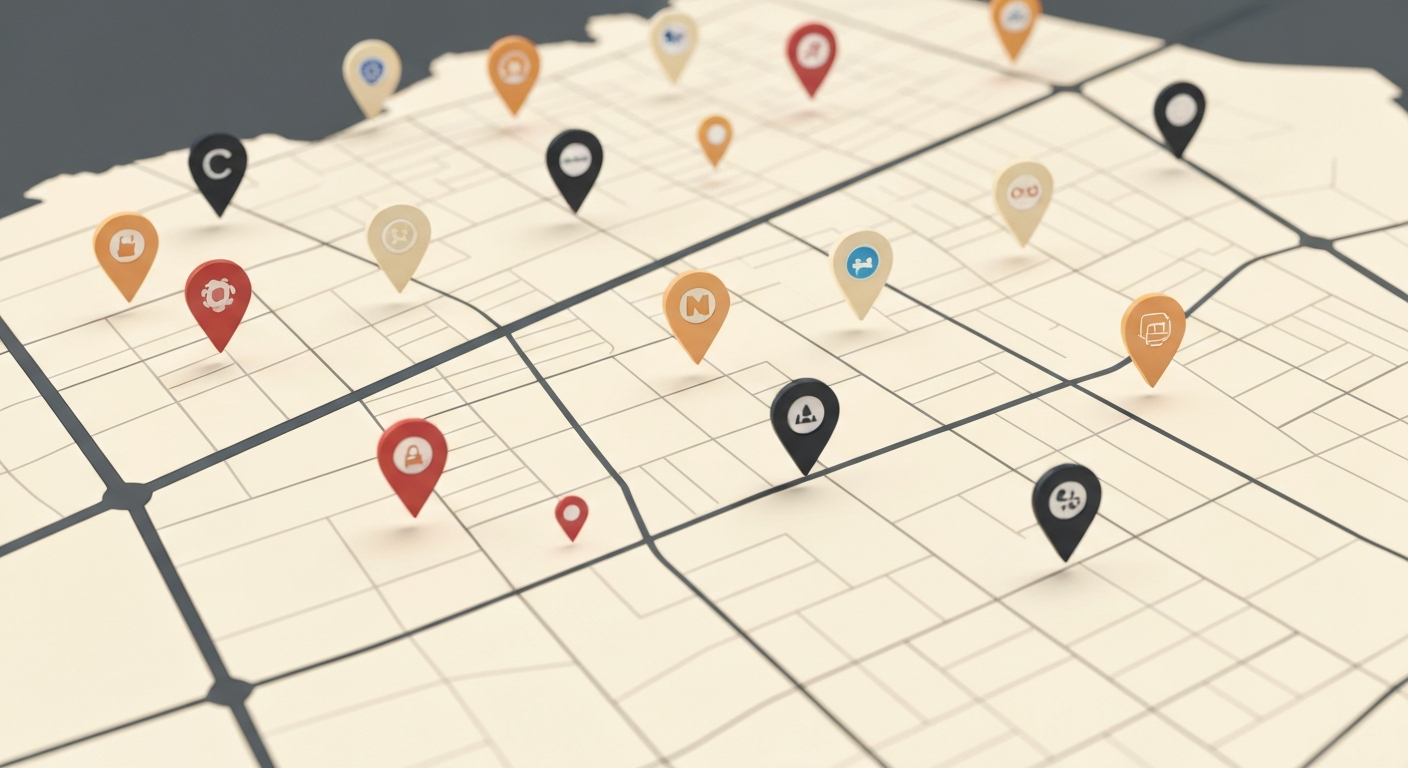
Consistent Information Across the Web.
Manage your business information across Google, Apple Maps, Siri, Bing, and directories to help customers and AI systems find accurate details.
What is Local Listings Management?
It is the process of maintaining consistent Name, Address, and Phone number (NAP) data, along with hours and services, across the internet. Consistent business information is critical for search engines, map applications, voice assistants, and AI-driven discovery platforms to trust and recommend your business.
Complete Presence Management
We work to maintain accurate business data everywhere your customers are searching.
Google Business Profile
Ongoing management of your primary listing, including category updates, holiday hours, and service descriptions.
Apple Business Connect
Optimization for Apple Maps and Siri, ensuring iOS users find accurate information and engaging photos.
Directory Distribution
Syndicating your accurate business data to dozens of high-authority directories and data aggregators.
Duplicate Suppression
Identifying and suppressing duplicate listings that confuse search engines and dilute your local authority.
Real-Time Updates
Pushing changes to business hours, holiday closures, or new services across the network from a single source.
Multi-Location Management
Centralized control for businesses with multiple locations to support brand consistency at scale.
The Evolution of Local Listings in the Era of AI Search
In the early days of local SEO, managing your digital presence meant submitting your website to a few online directories and hoping for the best. Today, the landscape is infinitely more complex. Your business information is no longer just consumed by human beings reading a screen; it is constantly being crawled, aggregated, and interpreted by highly sophisticated artificial intelligence systems, large language models (LLMs), and answer engines.
Local Listings and Digital Presence Management is the active, ongoing process of ensuring that your business’s core data—your Name, Address, Phone number (NAP), business hours, categories, and service descriptions—is perfectly consistent across the entire digital ecosystem. When your data is consistent, you build a strong, unambiguous "entity" in the eyes of search engines like Google, mapping applications like Apple Maps, and AI platforms like ChatGPT and Perplexity.
If your business information is fragmented—if Google thinks you close at 5:00 PM, but Yelp says 6:00 PM, and your website says 5:30 PM—you create "entity confusion." AI systems and search engines are designed to provide the most accurate, reliable answers to their users. If they cannot definitively verify your business details, they will simply bypass you and recommend a competitor whose data is clean and consistent.
Why NAP Consistency is the Foundation of AEO and GEO
Answer Engine Optimization (AEO) and Generative Engine Optimization (GEO) are built upon the concept of trust and authority. Before an AI Overview or a generative chat interface will cite your business as the definitive answer to a user's query, it must cross-reference your data against multiple authoritative sources.
The Role of Data Aggregators: The internet relies on major data aggregators (such as Foursquare, Data Axle, and Localeze) to distribute business information to hundreds of smaller directories, apps, and GPS systems. If your data is incorrect at the aggregator level, that bad data will propagate across the web, severely damaging your local search visibility.
Entity Resolution: AI models use a process called entity resolution to understand real-world objects, including your business. Consistent local listings act as strong signals that reinforce your business entity. Every accurate citation acts as a "vote of confidence" that your business is legitimate, operational, and located exactly where you claim it is.
Core Pillars of Digital Presence Management
At Dharma Digital Marketing, we take a comprehensive, technology-driven approach to managing your local listings. We do not just build a few citations; we actively govern your data across the most critical platforms on the web.
1. Google Business Profile (GBP) Governance
Your Google Business Profile is arguably your most important digital asset for local visibility. It dictates how you appear in Google Search, Google Maps, and the highly coveted Local 3-Pack. We provide ongoing, proactive management of your GBP.
This includes ensuring your primary and secondary categories are perfectly aligned with your services, optimizing your business description with semantic keywords, managing holiday hours to prevent customer frustration, and utilizing Google Posts to signal active engagement. We also monitor for unauthorized edits—often suggested by competitors or confused users—and reject them before they can damage your profile.
2. Apple Business Connect and Apple Maps
With millions of iOS users relying on Apple Maps and Siri for local discovery, ignoring the Apple ecosystem is a critical mistake. We claim, verify, and optimize your presence on Apple Business Connect.
We ensure that Siri can accurately provide your business hours, directions, and contact information. We also optimize your Apple Maps place card with high-quality photography, accurate service categories, and direct action links (such as booking an appointment or placing an order), ensuring a seamless experience for iPhone users.
3. Bing Places and Voice Search Ecosystems
Bing powers a significant portion of desktop searches and serves as the foundational data source for many voice assistants, including Amazon Alexa and Microsoft Copilot. We optimize your Bing Places for Business profile to ensure parity with your Google presence, capturing search volume that many competitors ignore.
4. Directory Distribution and Citation Building
Beyond the major search engines, we syndicate your accurate business data to dozens of high-authority, industry-specific, and hyper-local directories. This includes platforms like Yelp, YellowPages, Better Business Bureau, and specialized networks relevant to your specific industry (e.g., Avvo for attorneys, Healthgrades for medical professionals, Houzz for contractors).
This widespread distribution not only helps potential customers find you directly on those platforms but also builds the robust backlink profile and citation consistency required to dominate local search algorithms.
5. Duplicate Listing Suppression
Duplicate listings are a silent killer of local SEO. They often occur when a business moves, changes its name, or when a well-meaning employee creates a new profile instead of claiming an existing one. Duplicates confuse search engines, split your review equity, and lead customers to the wrong locations.
We utilize advanced scanning technology to identify duplicate listings across the web. We then execute the necessary protocols to merge or permanently suppress these duplicates, consolidating your authority into a single, powerful entity.
Multi-Location Digital Presence Strategy
For businesses with multiple locations—such as restaurant chains, regional healthcare providers, or franchise operations—managing digital presence becomes exponentially more difficult. A manual approach is impossible to scale.
Dharma Digital Marketing provides centralized data governance for multi-location brands. We utilize enterprise-grade technology to manage hundreds or thousands of listings from a single source of truth. If your brand rolls out a new service, updates holiday hours, or rebrands, we can push those changes instantly across the entire network, ensuring brand compliance and protecting your local visibility in every market you serve.
How Local Listings Power Voice Search and AI Assistants
When a user asks Siri, Alexa, or Google Assistant, "Where is the nearest emergency plumber that is open right now?", the voice assistant does not read a list of ten websites. It provides one, definitive answer.
To be that single answer, your business data must be flawless. Voice assistants pull their information directly from local listings, maps, and structured data. By maintaining perfect NAP consistency, updating your hours in real-time, and categorizing your services accurately, we position your business to capture the rapidly growing volume of voice search queries.
The Dharma Implementation Process
Our approach to Local Listings Management is methodical, data-driven, and continuous.
- Comprehensive Audit: We begin by scanning the entire digital ecosystem to assess the current state of your business information, identifying inaccuracies, missing profiles, and harmful duplicates.
- Data Standardization: We work with you to establish a single, approved standard for your Name, Address, Phone number, business description, and categories.
- Claiming and Verification: We manually claim and verify ownership of your core profiles on Google, Apple, and Bing to ensure you have ultimate control over your data.
- Syndication and API Integration: We deploy your standardized data through direct API connections to major aggregators and tier-one directories, ensuring rapid and accurate updates.
- Continuous Monitoring: Local presence is not a set-it-and-forget-it task. We continuously monitor your listings to protect against user-generated edits and ensure your data remains locked down.
- Performance Reporting: We provide transparent reporting on your search impressions, map views, direction requests, and phone calls generated directly from your local listings.
The Critical Role of Data Syndication and API Integrations
In the modern digital landscape, manually updating business information across hundreds of directories is an impossible task. It is not just about the initial setup; it is about maintaining that data over time as platforms merge, algorithms update, and competitors attempt to hijack your local presence. This is where advanced data syndication and direct API integrations become essential components of your connected growth system.
Direct API Connections: Dharma Digital Marketing utilizes enterprise-grade technology to establish direct API connections with the most critical publishers in the local search ecosystem. This includes direct pipelines to Google Business Profile, Apple Business Connect, Bing Places, and Facebook. When we update your holiday hours or add a new service category in our centralized dashboard, that data is pushed instantly to these tier-one platforms. This circumvents the traditional manual review processes that can delay updates by weeks or even months.
Aggregator Syndication: Beyond the tier-one platforms, we syndicate your standardized data to the major data aggregators (such as Data Axle, Foursquare, and Localeze). These aggregators act as the foundational data layer for the internet. They supply business information to thousands of smaller directories, GPS navigation systems (like Garmin and TomTom), in-car infotainment systems, and emerging mobile applications. By ensuring your data is pristine at the aggregator level, we essentially "vaccinate" your digital presence against bad data propagating downstream.
Continuous Data Locking: One of the most significant threats to your local SEO is unauthorized data manipulation. Competitors, disgruntled former employees, or simply confused users can submit "suggested edits" to your Google Business Profile or Yelp listing. If you are not actively monitoring these platforms, the algorithms may accept these edits automatically, changing your business hours, phone number, or even your website URL. Our technology continuously monitors your core listings. If an unauthorized change is detected, our system automatically rejects the edit and re-publishes your locked, standardized data, protecting your digital assets 24/7.
Integrating Local Listings with AI Search and Generative Engines
As search behavior shifts from traditional keyword-based queries to conversational questions powered by Large Language Models (LLMs) like ChatGPT, Gemini, and Claude, the importance of structured local data has never been higher. These generative engines do not "crawl" the web in the same way traditional search engines do; they rely on massive datasets and structured knowledge graphs to formulate their answers.
Feeding the Knowledge Graph: Google's Knowledge Graph is a massive database of entities (people, places, things) and the relationships between them. Your business is an entity. When you maintain perfect NAP consistency, utilize relevant schema markup on your website, and distribute your data across authoritative directories, you are feeding the Knowledge Graph. You are explicitly telling the AI, "This business exists, it is located here, it provides these services, and it is highly trusted by these third-party platforms." The stronger your entity signals, the more likely the AI is to feature your business in an AI Overview or a direct answer.
Answer Engine Optimization (AEO): When a user asks an AI, "What is the best highly-rated personal injury attorney near me that offers free consultations?", the AI must instantly evaluate thousands of potential businesses. It filters them based on location, category, review sentiment, and specific attributes (like "free consultations"). If your local listings are incomplete—if you haven't explicitly stated that you offer free consultations on your Google Business Profile and Apple Maps listing—the AI will exclude you from the answer. Comprehensive listings management ensures that every attribute, service, and amenity is documented, maximizing your visibility in these hyper-specific, AI-driven queries.
The Feedback Loop of Trust: AI systems prioritize trust and safety. They are designed to avoid recommending businesses that might be permanently closed, fraudulent, or poorly rated. Consistent local listings act as a verifiable trust signal. If Google sees that your data matches perfectly across 50 different authoritative directories, it dramatically increases its confidence in your business. This confidence translates directly into higher local rankings and increased inclusion in generative search results.
The Anatomy of a Perfectly Optimized Local Listing
Creating a local listing is easy; optimizing it for maximum visibility requires a strategic, detail-oriented approach. A perfectly optimized listing goes far beyond just your name, address, and phone number. It must be rich, engaging, and semantically relevant to your target audience.
- Primary and Secondary Categories: Selecting the correct primary category is the single most important ranking factor for your Google Business Profile. However, secondary categories are equally important for capturing long-tail search volume. We conduct extensive competitive analysis to identify the exact category combinations that drive the most qualified traffic in your specific industry.
- Semantic Business Descriptions: Your business description should not just be a generic marketing pitch. It must be carefully crafted to include semantic keywords, clearly define your core services, highlight your unique value proposition, and establish your geographic service area. This text is heavily analyzed by search algorithms to determine your relevance to specific queries.
- Comprehensive Service Menus: Many businesses fail to fully utilize the "Services" or "Products" sections of their local profiles. We meticulously build out these sections, detailing every service you offer, complete with descriptions and pricing (when applicable). This rich data helps AI systems understand the full breadth of your expertise.
- High-Quality Visual Assets: Listings with high-quality photos receive significantly more engagement, website clicks, and direction requests than those without. We manage your visual presence, ensuring that your logo, cover photo, interior shots, exterior shots, and team photos are professional, correctly formatted, and regularly updated.
- Strategic Q&A Management: The Q&A section of your Google Business Profile is often overlooked, but it is a powerful tool for Answer Engine Optimization. We proactively seed your profile with the most common questions your customers ask, and provide clear, authoritative answers. This not only helps potential customers but also provides structured Q&A data directly to the search engine.
- Google Posts and Updates: Search engines reward active, engaged businesses. We utilize Google Posts to share updates, special offers, new blog content, and company news directly on your profile. This signals to the algorithm that your business is vibrant and actively maintaining its digital presence.
Important Limitations and Context
While we utilize the most advanced tools available to distribute your data, it is important to understand the realities of the digital ecosystem.
Publisher Control: We cannot guarantee that every third-party publisher will immediately accept or display every update. Some niche directories have slow refresh cycles or manual review processes that are entirely outside of our control.
Not a Replacement for SEO: Perfect local listings are a prerequisite for local search success, but they are not a silver bullet. Listings management supports SEO, but it does not replace the need for a technically sound, content-rich, AI-ready website and a robust review generation strategy.
No Guaranteed Rankings: As with all marketing efforts, we do not guarantee specific Local 3-Pack placements or search rankings. Our goal is to provide search engines with the most accurate, trustworthy data possible, maximizing your opportunity to be featured prominently.
Industry-Specific Local Listings Strategies
Not all local businesses are created equal, and the way search engines evaluate your digital presence varies significantly depending on your industry. A strategy that works for a retail store will not necessarily work for a medical practice or a home services contractor. At Dharma Digital Marketing, we tailor our local listings approach to the specific nuances and requirements of your vertical.
Healthcare and Medical Spas
In the healthcare sector, trust and authority are paramount. Google applies strict "Your Money or Your Life" (YMYL) standards to medical queries. For medical spas, plastic surgeons, and dentists, local listings must be impeccably accurate. We focus on building citations on specialized healthcare directories like Healthgrades, Vitals, and Zocdoc. Furthermore, we navigate the complexities of practitioner vs. practice profiles. If you have multiple doctors operating out of a single clinic, we ensure that both the clinic's main profile and the individual practitioners' profiles are optimized correctly without cannibalizing each other's search visibility. We also ensure that specific attributes, such as "accepts new patients" or specific insurance networks, are clearly defined across all platforms.
Home Services and Contractors
Plumbers, electricians, roofers, and HVAC technicians often operate as Service Area Businesses (SABs). Unlike a restaurant or a retail store, SABs travel to the customer's location rather than receiving customers at a storefront. This requires a fundamentally different approach to local listings. We optimize your profiles to accurately reflect your precise service areas—down to the specific zip codes and neighborhoods you cover—while adhering to Google's strict guidelines regarding hiding physical addresses when appropriate. We also prioritize platforms that matter most to homeowners, such as HomeAdvisor, Angi, Houzz, and the Better Business Bureau, ensuring your reputation is strong where high-intent decisions are made.
Restaurants and Hospitality
For restaurants, cafes, and event venues, local search is highly transactional and driven by immediate intent (e.g., "restaurants near me open now"). We focus heavily on menu integration, reservation links, and ordering platform consistency. If your menu changes, or if you adjust your hours for a holiday, that information must be pushed instantly to Google, Apple Maps, Yelp, and TripAdvisor. We also optimize for specific dining attributes such as "outdoor seating," "wheelchair accessible," "live music," or "kid-friendly," as these are the exact filters users—and AI assistants—apply when choosing a dining destination.
Legal and Professional Services
For personal injury attorneys, CPAs, and financial advisors, local listings must project absolute professionalism and expertise. We prioritize citations on authoritative legal and financial directories such as Avvo, FindLaw, Martindale-Hubbell, and specialized financial networks. We ensure that your areas of practice are meticulously categorized and that your business description clearly articulates your unique value proposition and track record. In highly competitive legal markets, the depth, accuracy, and authority of your local citation profile can be the deciding factor in outranking established competitors.
The Cost of Ignoring Your Digital Presence
Many business owners view local listings management as a low-priority administrative task. This is a dangerous misconception. In today's hyper-competitive digital landscape, ignoring your local presence has severe, measurable consequences for your bottom line.
Lost Revenue from Misinformation: If a potential customer searches for your business, sees that you are "Closed" (because your hours are incorrect on Apple Maps), and drives to a competitor instead, you haven't just lost a single sale; you have potentially lost the lifetime value of that customer.
Erosion of Search Rankings: Search algorithms crave certainty. If your business data is a chaotic mess of old phone numbers, incorrect addresses, and duplicate profiles, Google loses confidence in your business. When confidence drops, rankings drop. You will slowly be pushed out of the Local 3-Pack and replaced by competitors who have invested in data governance.
Vulnerability to Competitor Sabotage: Unmanaged profiles are vulnerable profiles. Unscrupulous competitors can, and do, suggest malicious edits to your Google Business Profile—changing your website link to an affiliate site, marking your business as permanently closed, or altering your phone number. If you are not actively monitoring and locking down your data, you are leaving your most valuable digital asset exposed to sabotage.
Invisibility in the AI Era: As we transition into the era of AI search and generative engines, the cost of bad data is absolute invisibility. AI models do not guess; they rely on structured, verifiable facts. If your facts are not in order, the AI will simply ignore you.
Frequently Asked Questions
Why do I need to manage directories if I already have a Google Business Profile?
Google does not operate in a vacuum. Its algorithm cross-references your Google Business Profile data against dozens of other authoritative directories (like Apple Maps, Bing, Yelp, and data aggregators) to verify your business's legitimacy. If your data is inconsistent across the web, Google loses trust in your entity, which can severely damage your local rankings.
What is Name, Address, and Phone number (NAP) consistency?
NAP consistency means that your business name, physical address, and primary phone number are written exactly the same way across every website, directory, and social media platform on the internet. Even minor variations (like 'St.' vs. 'Street' or an old phone number) can confuse search engines and dilute your local authority.
How long does it take to fix inaccurate local listings?
While we can push updates immediately through direct API integrations to tier-one networks, the complete process takes time. Some smaller publishers take weeks or even months to process changes, refresh their databases, or manually review requests to merge duplicate listings.
What is Apple Business Connect and why does it matter?
Apple Business Connect is Apple's official platform for managing how your business appears across Apple Maps, Siri, Apple Wallet, and other Apple services. With a massive portion of mobile users relying on iOS devices for local discovery and navigation, optimizing your presence here is critical for capturing high-intent local traffic.
How do duplicate listings happen?
Duplicate listings are incredibly common. They often occur when a business moves to a new location, changes its phone number, or undergoes a slight name change. They can also be created automatically by data aggregators scraping outdated public records, or by well-meaning employees who create a new profile instead of claiming an existing one.
Can you help if I have multiple business locations?
Yes. Managing digital presence for multi-location businesses is one of our core competencies. We use centralized, enterprise-grade technology to manage hundreds of listings from a single dashboard, ensuring brand consistency and accurate local data for every single branch or franchise location.
Does managing my listings help with voice search?
Absolutely. Voice assistants like Siri, Alexa, and Google Assistant rely heavily on structured local data to provide definitive answers to users. By ensuring your hours, location, and service categories are perfectly accurate across the ecosystem, you significantly increase the likelihood of being the recommended answer for voice queries.
What happens if a competitor tries to change my business hours on Google?
Google allows users (including competitors) to 'suggest an edit' to your profile. If you are not actively managing your listings, Google may accept these edits automatically. Our continuous monitoring systems detect unauthorized changes and lock down your core data, protecting your profile from malicious or accidental alterations.
Do I still need local listings if I run Google Ads?
Yes. While Google Ads can buy you immediate visibility, local listings provide the foundational organic trust that consumers and search engines demand. Furthermore, a well-managed Google Business Profile is actually required to run Local Services Ads and to utilize location extensions in your standard Google Ads campaigns.
Will this guarantee that I show up in the Google Local 3-Pack?
No. While perfect NAP consistency and active listings management are critical foundational elements of local SEO, they do not guarantee placement in the Local 3-Pack. Rankings are influenced by many factors, including proximity to the searcher, review velocity, website authority, and overall market competition.
Is Your Business Information Accurate?
Let's run a scan of your digital presence to identify inconsistencies and opportunities.
REQUEST A FREE MARKETING AUDIT